
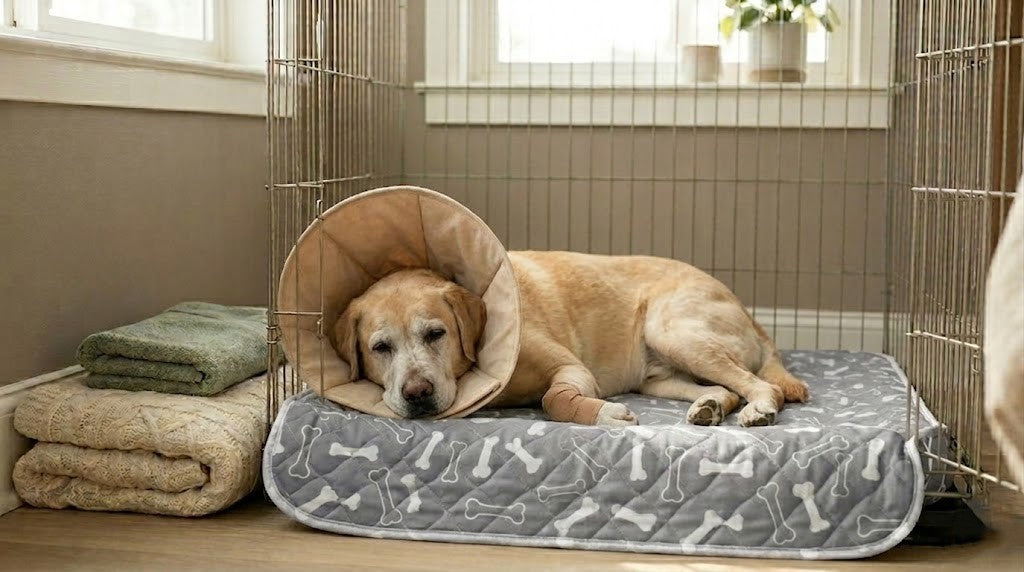
The first 72 hours after a TPLO surgery are the ones your vet doesn't fully prepare you for.
Your vet gave you a discharge packet. A page of medication times. A folded-up illustration of where the incision is. A phone number to call if you see any drainage. A laminated card that says No bathing, no off-leash, no jumping, no stairs in red.
What your vet did not give you — what no aftercare instructions in any veterinary practice in America fully prepare you for — is what 3am looks like the first night home.
Your dog cannot get up to go outside.
She can hobble three feet. She cannot do stairs. She cannot squat. She has a cone on. The cone catches on every surface above six inches. She has a 4-inch incision running down her right hind leg and the rule, the only rule, is the wound area cannot get wet. Not from a slipped backing. Not from a soaked-through pad. Not from her own urine spreading in the wrong direction.
You will not sleep through the night for fourteen days.
What we built for the two weeks after surgery.
PuddleMat started for a senior golden retriever named Mabel, who couldn't get up to go out for different reasons. But what we ended up building for hospice care turned out to be exactly what post-op care needs.
The first 72 hours are the ones the discharge packet doesn't fully cover. After that, the next eleven days are some version of the same problem with diminishing intensity. Five things PuddleMat handles that disposable pads usually don't:
- The cone problem. Disposable pads have raised plastic edges that the cone catches on. Your dog learns, on day one, that walking onto the pad means snagging the cone, which means a sharp tug at the recently-shaved skin around her cone collar, which means she stops walking onto pads. PuddleMat is flat. The fabric continuous. The cone glides.
- The wound-water problem. Slipped backings wick urine sideways. Sideways means toward the incision. Wound contamination from urine is one of the more avoidable post-op infections. GripFloor doesn't slide. The pad stays. Liquid travels down, not sideways.
- The transfer problem. You're going to lift her onto the pad. Or onto a towel. Or onto your lap. You need the pad to be in the place you set it. Hardwood plus disposable plus silicone grid means: pick a different friction. PuddleMat picks the right one.
- The crinkle problem. Post-op dogs are sound-sensitive. Anesthesia hangover. Pain medication. Confusion. The crinkle of disposable pads triggers exactly the kind of head-jerk that a dog with stitches in her hindquarters cannot afford. Whisper Top is functionally silent.
- The urine-color problem. Post-op dogs sometimes develop UTIs from catheterization during surgery. The earliest sign is urine color shift. The light interior on PuddleMat shows that shift clearly — useful when you're checking on a recovering dog every few hours.
The size that fits the medical crate.
The Medium PuddleMat is 80 × 70 cm. It fits the inside of a standard medical-rest crate exactly. The Large is 90 × 80 cm — for the dog who is on extended bed rest in a corner of the bedroom because she can't do stairs to her usual spot.
The pad holds up across many hot-wash cycles. You'll use the wash a lot during recovery. The wash cycle isn't where it fails.
Two weeks.
Recovery is two weeks of half-sleep, alarm clocks set for medication, learning to read your dog's pain face. The pad is the smallest part of it. But the small parts are the ones that compound — the crinkle that wakes her up, the slipped backing that wets her stitches, the dark interior that hides the early UTI.
Your vet might recommend it. Surgical centers don't sell pads — they sell the surgery.
We sell the pad.
For the two weeks after surgery — and the two weeks you didn't think you'd survive.